Vancouver kitchen renovations rank among the most expensive home upgrades in the country. A mid-range kitchen — new cabinets, countertops, appliances, and tile — runs $45,000 to $90,000. A custom kitchen on the West Side or North Shore regularly reaches $120,000 to $180,000, especially in homes where the kitchen anchors a full main-floor renovation.
At those numbers, mistakes don’t just cost money. They cost the kitchen you actually wanted.
What’s surprising is how rarely the mistakes happen on site. Most kitchen renovation mistakes are made during planning — before a single cabinet is ordered or a wall is opened. And the costliest ones almost always trace back to the same root cause: design and construction happening separately, without enough coordination between them.
After designing and building [X] kitchens across Vancouver — from Kerrisdale character homes to North Shore custom builds to Yaletown condos — we’ve seen every version of these mistakes. Here are the ten most common, and what actually prevents them.
Mistake #1: Prioritizing Looks Over Workflow
The work triangle — the distance between your sink, range, and refrigerator — determines how functional your kitchen actually is. Each leg should measure between 4 and 9 feet, with a total perimeter no greater than 26 feet. That geometry is what makes a kitchen efficient to use, not just impressive to photograph.
What goes wrong: homeowners see an oversized island on Instagram and commit to it before mapping how the triangle works around it. The result is a kitchen that looks beautiful and exhausts you to cook in. A sink 12 feet from your range. A refrigerator tucked into a corner that interrupts the flow between prep and cooking. Fifteen steps to make coffee instead of five.
This mistake is particularly common in Vancouver’s older housing stock. Homes built in the 1950s through 1970s have small, often galley-style kitchens. When homeowners open the floor plan — frequently by removing walls — they overcorrect. The kitchen becomes too large. The work triangle stretches beyond useful distances. The space feels like a showroom instead of a workspace.
The fix begins before any design is drawn. Map your actual cooking workflow. Where do you prep? Where do you plate? Walk through making a typical dinner. If any two work zones are more than 9 feet apart, the layout needs reconfiguring before it gets to paper — not after cabinets have been ordered.
Mistake #2: Skipping Permits for Structural or Plumbing Changes
Any kitchen renovation that involves moving a wall, relocating a sink or dishwasher, rerouting a gas line, or adding or moving an electrical circuit requires a building permit from the City of Vancouver. This isn’t a technicality — it’s a legal requirement under the BC Building Code, and it applies whether or not your contractor mentions it.
The City of Vancouver is known for permit timelines that run 8 to 12 weeks for residential kitchen renovations involving structural or mechanical work. That timeline is part of your project schedule whether you plan for it or not. Municipalities like Burnaby and Coquitlam tend to process faster; the North Shore has its own requirements and timelines. An experienced local team knows all of this and builds it into your project from the start.
What goes wrong when permits are skipped: the work gets done, the kitchen looks finished — and then the home is listed for sale. A building inspection flags unpermitted structural changes. The buyer’s insurance company asks questions. A city inspector responds to a neighbour’s complaint mid-renovation. In each case, the homeowner absorbs the cost and disruption.
An integrated Design+Build team manages the full permit process — submitting applications, responding to city requests, coordinating inspections — as part of your project. If something gets flagged, resolving it is the contractor’s responsibility, not yours.
Mistake #3: Ignoring Strata Rules (For Condo and Townhouse Owners)
This is the most commonly overlooked mistake in renovation content — and it affects nearly half of Metro Vancouver homeowners.
Roughly 40% of Metro Vancouver residents live in strata properties: condos, townhouses, and row homes governed by strata corporations under the BC Strata Property Act. Strata renovation restrictions vary by building, but common examples include: changes to plumbing stacks or drain lines, adding or modifying exhaust venting through exterior walls, replacing flooring with hard surfaces (sound transmission requirements), and any modification to a structural element.
The mistake: homeowners order cabinets, schedule demo, and begin renovating — then discover mid-project that strata approval was required for the ventilation upgrade or the plumbing relocation. Strata councils can require restoration of unpermitted work at the homeowner’s expense, and they routinely do.
Strata approval timelines typically run 4 to 8 weeks and must happen before materials are ordered and before demo is scheduled. An experienced Design+Build team identifies strata-applicable items at the design phase, submits applications early, and builds the approval timeline into the project schedule — so it’s an anticipated step rather than an unexpected delay.
Mistake #4: Hiring a Separate Designer and Contractor
The most common way Vancouver homeowners organize a kitchen renovation: hire a kitchen designer or interior designer, get drawings, then hire a general contractor to build from them. This sounds like a sensible division of labour. In practice, it creates a gap that costs money.
Designers create plans without deep construction knowledge. Contractors discover buildability problems during demo — a wall that turned out to be structural, plumbing that doesn’t go where the drawing assumed, a ceiling height that won’t accommodate the custom range hood. The two parties negotiate over who’s responsible. Change orders are issued. The homeowner pays for the gap between what was designed and what can actually be built.
An integrated Design+Build firm eliminates that gap. The designers and the construction team are colleagues who work from the same drawings, the same budget, and the same timeline. Constructability is reviewed at the design stage, before it costs anything. When the design is approved, the team that approved it builds it.
This is why Design+Build projects consistently deliver fewer surprises and tighter final costs than the design-then-build model. The coordination that would otherwise fall between two separate companies is internal.
Mistake #5: Skimping on Ventilation
A $380 ductless range hood recirculates air through a charcoal filter. It removes roughly 15% of cooking odours and zero moisture or grease. Homeowners install them because they’re inexpensive and require no ductwork. Then they spend years wondering why the kitchen always smells like yesterday’s dinner.
Vancouver’s climate makes this worse. With nearly 300 days of precipitation annually and kitchens that run dark and enclosed from October through April, moisture management in the kitchen directly affects the lifespan of your cabinets — particularly upper cabinets near the range, which absorb grease and humidity from below.
What you actually need depends on your appliances:
- Gas range: minimum 400 CFM, ducted to the exterior. For a 36-inch range or wider: 600 CFM minimum.
- Electric or induction range: minimum 300 CFM, ducted out.
- Ductless (recirculating) hoods: acceptable only in condos or strata buildings where exterior venting is prohibited — and only with induction or electric ranges.
Budget $1,800 to $3,500 for a proper hood plus ductwork installation — routing to roof or exterior wall, flashing, and electrical connection. This is not a line item to optimize. The grease accumulation on your cabinetry over the next decade costs more than the proper hood would have.
Mistake #6: Underestimating Storage — Especially Depth and Vertical Space Standard
Standard cabinet packages are designed around linear footage and industry formulas — not your actual belongings. The result: a renovated kitchen with 32 linear feet of cabinets that can’t fit a stand mixer, has nowhere for baking sheets, and leaves a row of small appliances permanently on the counter because the cabinets weren’t designed for them.
Vancouver’s smaller home footprints amplify this problem. When a 140 square foot kitchen has to function as the primary storage space for a full household, every linear foot has to work harder than the standard formula assumes.
Three things to get right in the storage plan:
- Deep drawer banks in base cabinets instead of shelves. Drawers provide approximately 70% better access to the full depth of the cabinet. Plan for 40 to 50% of base cabinets as drawer stacks rather than door-and-shelf units.
- Cabinets to ceiling. The gap between upper cabinets and ceiling wastes 30% of your vertical storage capacity and collects grease and dust. Take cabinets to the ceiling — add glass doors on the upper section if you want the visual lightness without losing the storage.
- An appliance garage. A dedicated counter-level cabinet with doors and integrated outlets for coffee maker, toaster, and similar appliances. Keeps surfaces clear without removing things you use daily.
Inventory your actual belongings before finalizing cabinet layouts. Measure the largest items. Design around what you own and how you cook — not around what a standard package delivers.
Mistake #7: Getting Lighting Wrong for Vancouver Winters
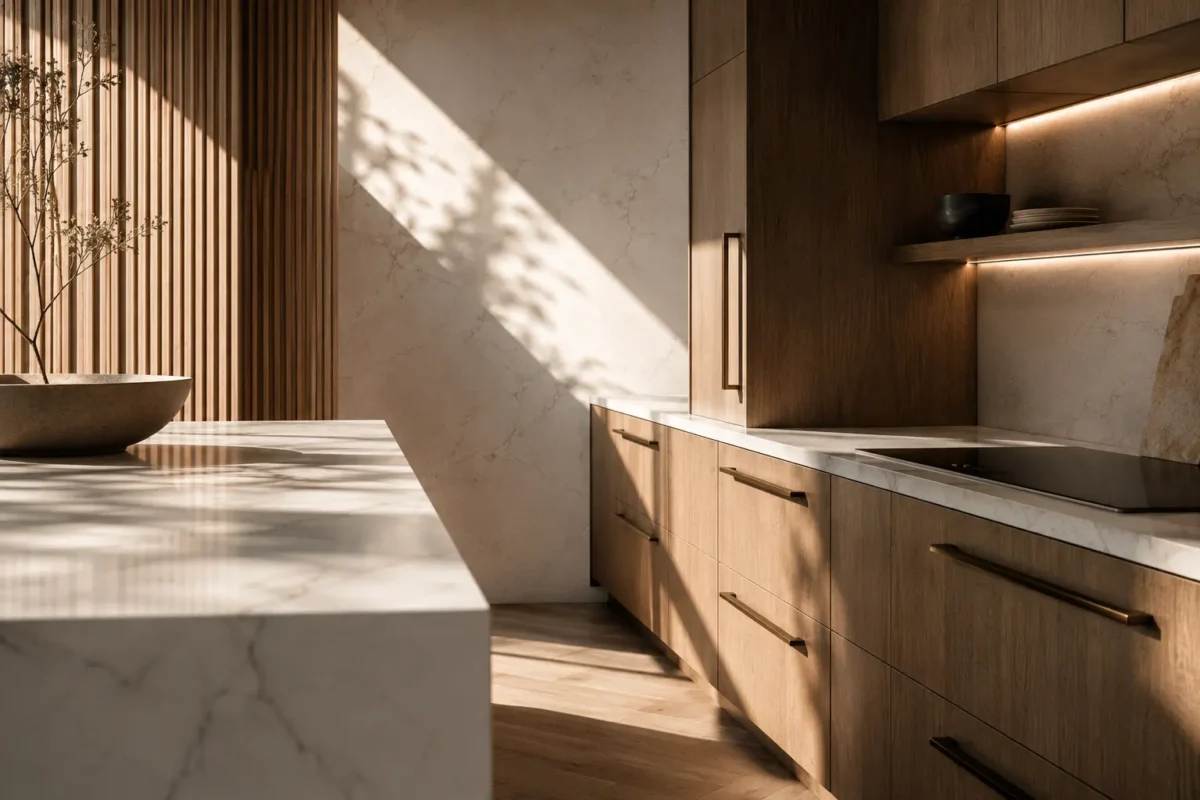
Homeowners spend $8,000 on custom cabinetry detail and $400 on a single overhead light fixture. The result in a north-facing Vancouver kitchen in January: chopping vegetables in your own shadow, a backsplash tile that’s invisible after 4 PM, and a kitchen that feels like a cave from October through April — which is most of the year.
Proper kitchen lighting has three distinct layers, and all three are required for a Vancouver kitchen to work:
- Ambient — recessed pot lights on dimmers. General overhead illumination. Necessary, but not sufficient on its own.
- Task — under-cabinet LED strips that illuminate the counter surface directly, eliminating the shadow your body casts when working under overhead light. These are non-negotiable in Vancouver kitchens. Install them before the backsplash tile goes up; retrofitting after tile installation costs three times as much. Budget $45 to $85 per linear foot, installed.
- Accent — pendants over the island, toe-kick lighting for nighttime navigation, interior lighting for glass-front cabinet displays. These shift the kitchen from functional to atmospheric and make entertaining in the kitchen feel intentional.
Put ambient and task lighting on separate circuits with separate switches. A single switch that controls everything forces you to choose between bright work lighting and bright ambient simultaneously — good for cooking prep, bad for dinner parties. Dimmer switches on ambient and accent circuits: $85 to $120 per switch installed.
Mistake #8: Ordering Cabinets and Appliances Too Late
Custom cabinets in Metro Vancouver currently run 12 to 16 weeks from order to delivery. High-end appliances — Wolf, Sub-Zero, La Cornue, Miele — run 16 to 24 weeks, sometimes longer for custom configurations. These lead times are not negotiable and they don’t pause while you make up your mind.
The typical sequence: homeowners wait for permit approval before committing to orders (understandable — they want to confirm the project is proceeding). City of Vancouver processes permits in 8 to 12 weeks. Permits arrive. Homeowners order cabinets. Cabinets arrive 14 weeks later. The kitchen sits demo’d and gutted for 10 weeks — no cabinets, no countertops, no function — waiting on materials.
The fix: finalize cabinet and appliance selections during the permit application phase, not after permit approval. Submit orders when permits are submitted. Cabinets and appliances arrive when permits do. Demo starts immediately. Cabinets install in the first two weeks of construction rather than the third month.
This requires locking in your design — selections, finishes, dimensions — before the permit application is filed. Which requires having a design team and construction team aligned before the permit stage. Which is, again, why integrated Design+Build projects consistently run shorter timelines: the selections are finalized during design, not after permits clear.
Mistake #9: Committing Permanent Elements to Trendy Finishes
Matte black cabinetry. Deep navy lower cabinets with white uppers. Two-tone Shaker with unlacquered brass hardware. All of these look exceptional right now. All of them will look dated in 5 to 7 years. Vancouver kitchen renovations cost $45,000 to $120,000. You are not in a position to redo the kitchen in 2031 because the navy cabinets feel wrong.
The rule is simple: commit permanent elements to timeless choices, and reserve trends for the replaceable elements.
- Cabinets — white, warm off-white, soft grey, or natural wood tones. All of these have 30-year track records of not looking dated. That’s what timeless means.
- Countertops — white, grey, or black quartz or granite in a clean, simple pattern. The veining is where you can add personality without risk.
- Backsplash tile — simple subway, large-format stone look, or classic hex. The pattern is where you get visual interest without a 10-year commitment.
- Hardware — this is where you trend. Thirty cabinet pulls cost $380 to $650 and take an afternoon to swap. Change them every 5 to 7 years and your kitchen always feels current.
Committing your cabinets to a trend colour because it looks spectacular in 2026 is a $15,000 to $25,000 decision you’ll evaluate every morning for the next decade. Trend through what you can replace cheaply.
Mistake #10: Not Budgeting for Hidden Work
This is not a risk to mitigate. In Vancouver’s housing stock — with a significant proportion of pre-1970s construction across East Vancouver, Kitsilano, the West Side, and the North Shore — hidden conditions are virtually guaranteed in any kitchen renovation that opens walls or floors.
Knob-and-tube wiring. Asbestos in drywall compound, floor tile adhesive, or duct insulation. Cast iron drain lines at end of service life. Subfloor rot around the original sink position. Inadequate structural members in walls that weren’t known to be load-bearing. In pre-1970s Vancouver homes, at least one of these conditions appears in the majority of kitchen demo projects.
Standard renovation advice is a 15 to 20% contingency on top of your stated budget. In Vancouver, treat that as the floor, not the ceiling — and plan for it at the start, not as an emergency fund you hope not to use.
What distinguishes experienced teams from less experienced ones isn’t whether they encounter hidden work. Everyone encounters it. What distinguishes them is the ability to anticipate and plan for it based on home age, construction type, and neighbourhood context — so that discoveries during demo are confirmation rather than crisis. A contractor who has completed 50+ renovations in East Vancouver character homes knows what to expect behind the walls of a 1963 bungalow. That knowledge belongs in your estimate from the beginning.
The Pattern Behind All 10 Mistakes
Look at the list again: work triangle errors, permit gaps, strata oversights, coordination failures, material delays. Almost every mistake on it happens before demo begins — in the planning phase, the design phase, or the contractor selection phase. And almost every mistake is preventable with the right team structure.
An integrated Design+Build firm reviews workflow and constructability during design. It manages permits and strata approvals as part of the project timeline. It coordinates material orders during the permit phase so nothing is waiting on delivery when construction is ready to move. It builds realistic hidden-work estimates into the budget from day one.
We take on this kind of work as part of a full home renovation in Vancouver.